
Many buyers hear “silicone is resistant,” then the seal swells, softens, or starts leaking. The mistake usually comes from one missing detail: the exact chemical and the temperature.
Silicone rubber has good chemical resistance to water, many dilute acids and bases, and many polar fluids, and it has excellent resistance to ozone and weather. Silicone rubber is usually weak in fuels, many oils, and many non-polar solvents, so “chemical resistant” is not universal.

I treat chemical resistance as a risk map. I do not treat it as a label. I always connect the fluid name, concentration, temperature, and exposure time. I also connect the part shape because thin seals fail faster than thick ones.
What Does “Chemical Resistance” Mean for Silicone Rubber?
Many discussions stay at the level of “good” or “bad.” That language hides the real failure mode and causes wrong material choices.
For silicone rubber, chemical resistance means how much the rubber changes after exposure, including swelling, softening, hardness drift, strength loss, and compression set growth. A seal can look fine and still fail because it loses sealing force.
I define chemical resistance by failure mode, not by marketing words
When I review a silicone part, I break “chemical resistance1” into measurable changes. I do this because seals fail in predictable ways.
✅ I watch these changes first:
- ✅ Volume change (swell or shrink)2
- ✅ Hardness change (Shore A drift)3
- ✅ Tensile and elongation loss4
- ✅ Compression set increase5
- ✅ Surface damage (cracks, tack, chalking)6
- ✅ Permeation (vapor passes through)7
A buyer can accept a seal that swells slightly if the joint still holds force. A buyer cannot accept a seal that loses rebound and stops pushing back. That is why I treat compression set as a core indicator for sealing life.
Temperature decides8 whether “resistant” stays true
I always say this in simple words: heat makes chemistry faster. A chemical that causes little change at room temperature can cause big swelling at 120 °C. A mild cleaner that looks safe in a short wipe can cause problems after daily hot wash cycles.
✅ I ask for:
- ✅ Continuous temperature at the seal location
- ✅ Peak temperature and time at peak
- ✅ Exposure type: wipe, splash, immersion, or vapor
- ✅ Exposure time: minutes per day or 24/7
Thickness and design9 change the outcome
I have seen the same silicone compound pass a soak test in a thick gasket, then fail in a thin lip seal. The thin section absorbs fluid faster. The thin edge also carries higher local stress. The part fails earlier even when the chemistry is the same.
🛠️ I treat these design features as risk multipliers:
- Thin lips and knife edges
- High squeeze in a tight groove
- Dynamic motion and friction
- Large temperature cycling
A simple “chemical resistance” table I use in reviews
| What changes | What it usually causes in seals | What I do next |
|---|---|---|
| Swelling | Extrusion, dimensional drift, leakage | Check groove fill and gaps |
| Softening | Wear, tearing, loss of clamp stability | Check tear risk and motion |
| Hardening | Cracks, leakage from poor conformity | Check heat aging and set |
| High compression set | Loss of sealing force over time | Match set test to service temp |
| High permeation | Odor, vapor leak, pressure loss | Consider barrier design or new elastomer |
I keep the language practical because procurement needs decisions, not only lab theory.
Which Chemicals Is Silicone Rubber Usually Resistant To?
Many buyers think silicone only matters for heat. I often see silicone selected because the environment is hot and wet, not oily.
Silicone rubber is usually resistant to water, many dilute acids and bases, many salts, and many polar fluids. It also resists ozone and weather very well, so it performs well outdoors when chemical exposure is mild.
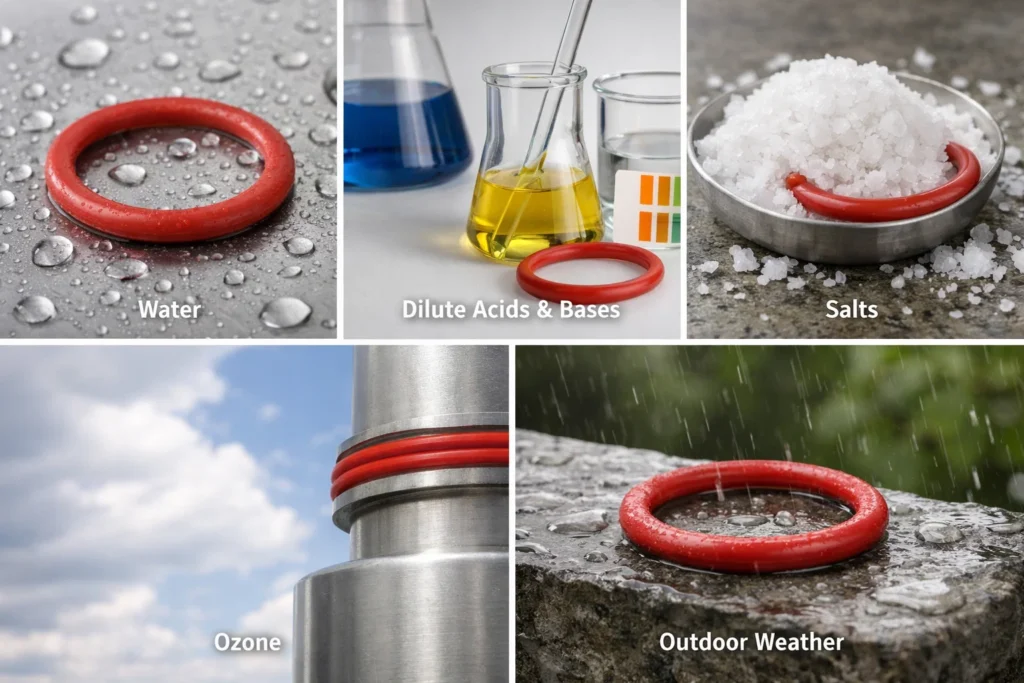
Silicone performs well in water and many mild process fluids
I often see silicone work well in:
- Hot air plus humidity
- Water splash and condensation
- Many dilute cleaning solutions
- Mild acids and mild alkalis at moderate conditions
Silicone also stays flexible across hot and cold. That matters when a seal faces heat cycles. It also matters when the seal must stay soft after cold storage and then go back to warm operation.
Silicone is strong against ozone, UV, and outdoor aging
When a seal sits outdoors, the environment is not only chemical. The environment also includes ozone, UV, and weather cycles. Silicone usually handles those stresses well. This is why I often see silicone used in outdoor covers, enclosures, and weather seals.
✅ Outdoor strengths I rely on:
- ✅ Ozone resistance10
- ✅ UV stability11 in many designs
- ✅ Flexibility in cold weather
- ✅ Stable feel after heat cycles
A practical “often compatible” list for silicone
This list is not a guarantee. It is a starting point for screening. I still confirm by testing.
| Chemical family | Silicone rubber12 typical behavior | Common seal examples |
|---|---|---|
| Water and steam condensate | Often good | Door seals, enclosure gaskets |
| Dilute acids | Often good | Wash-down gaskets (mild) |
| Dilute alkalis | Often good | Light cleaning exposure |
| Salt solutions | Often good | Outdoor equipment seals |
| Ozone and weather | Excellent | Outdoor gaskets and boots |
I still ask “what is inside the water”
Water is not one thing. I ask if the water includes:
- Chlorine and disinfectants
- Glycol mixes
- Detergents and surfactants
- Oils from pumps and compressors
I have seen “water service” seals fail because the system had oil mist. The buyer did not list it because it was not part of the process fluid. The seal still met it. The rubber still reacted.
✅ My rule: I treat “incidental chemicals13” as part of the spec.
Which Chemicals Attack Silicone Rubber?
Many failures happen because someone assumes silicone is “chemical resistant” in general. The usual surprise is fuel, oil, or solvent exposure14.
Silicone rubber is usually weak against fuels, many mineral oils, and many non-polar solvents. These fluids can cause swelling, softening, and fast loss of sealing force, especially at high temperature and long exposure.

Why fuels and oils change silicone fast
Many oils and fuels are non-polar. Silicone rubber often absorbs them. The rubber swells. The hardness drops. The seal becomes easy to extrude. The part can also tear during removal because it becomes softer and tacky.
I have seen a silicone gasket hold fine in hot air. Then a maintenance team used a grease during installation. The grease was enough to start swelling over time. The seal started to creep. The joint began to leak in weeks, not years. I will replace this story later, yet the pattern is common.
Solvents can create fast failure
Some solvents attack silicone quickly. The failure can look like:
- Sudden swelling
- Surface softening
- Loss of strength
- Permanent deformation
I do not guess with solvents. I ask for the solvent name and concentration. I also ask for temperature and exposure time. Small changes matter.
A “high risk for silicone” compatibility table
| Fluid type | Silicone risk level | Typical failure pattern | Better first check |
|---|---|---|---|
| Gasoline and fuel blends | High | Swell, soften, leak | Consider FKM15 first |
| Diesel and hot oil | High | Swell, set increases | Consider FKM or HNBR |
| Mineral oils and grease | Medium to high | Dimensional drift | Confirm by soak test16 |
| Non-polar solvents | High | Rapid damage | Test with real solvent |
| Unknown “shop chemicals” | Medium to high | Surprise failures | Ask for full chemical list |
Permeation is a silent problem in vapor service
Even when silicone does not dissolve, vapor can pass through it. This matters in:
- Odor control
- Vacuum sealing
- Pressure retention
- Fuel vapor environments
A seal can look perfect and still fail system requirements because molecules pass through the rubber. I treat permeation17 as a functional risk, not a cosmetic issue.
✅ My rule: if the job involves fuels, oils, or solvents, I do not call silicone “chemically resistant” unless I have data at the right temperature.
How Do I Test and Specify Silicone Rubber Chemical Resistance for Seals?
Many test plan18s fail because they use the wrong temperature or the wrong exposure type. A short room-temperature soak can miss the real risk.
To specify chemical resistance for silicone seals, I match the test fluid, temperature, and exposure type to the real service, and I measure volume change, hardness change, tensile change, and compression set. I also document sample thickness and time.

I start with a clear media list
I ask for a list that includes:
- Fluid name and grade
- Concentration
- Continuous temperature and peak temperature
- Exposure: wipe, splash, immersion, or vapor
- Exposure time and cycle pattern
- Cleaning and installation lubricants
This list saves time later. It also reduces disagreements because both sides talk about the same conditions.
I define acceptance limits that match sealing function
A seal does not need to look unchanged. A seal needs to keep sealing force and dimensions inside the design margin.
✅ I often use acceptance limits like:
- ✅ Volume change limit (example: small % range, based on design margin)
- ✅ Hardness change limit (Shore A drift range)
- ✅ Compression set limit at service temperature
- ✅ No cracks, no sticky surface, no severe surface damage
I keep the limits practical. I connect them to groove fill and squeeze. A thick gasket can tolerate more change than a thin O-ring in a tight groove.
A test plan table I use for buyer-friendly reporting
| Test item | What I measure | Why it matters for seals |
|---|---|---|
| Soak test | Volume and mass change | Predicts swell and drift |
| Hardness before/after | Shore A change | Predicts conformity and extrusion risk |
| Tensile and elongation | Strength loss | Predicts tearing and handling risk |
| Compression set | Set at service temp | Predicts long-term sealing force |
| Visual check | Surface damage | Predicts crack and tack risk |
I match exposure type to real life
A wipe exposure is not the same as immersion. A vapor exposure19 is not the same as splash. I have seen projects pass immersion tests yet fail in vapor because permeation drove performance issues. I have also seen projects pass short tests yet fail after repeated thermal cycles.
✅ I also record:
- Sample thickness
- Cure and post-cure status
- Time in fluid
- Number of cycles
These details explain results. They also make repeat testing possible.
When Should I Choose Silicone vs EPDM vs FKM for Chemical Exposure?
Many buyers want one rubber for all chemicals. I do not promise that because the environment always wins.
For chemical exposure, silicone is often best for hot air and mild chemicals, EPDM is often best for water-based fluids and weather, and FKM is often best for oils, fuels, and many chemicals at high temperature. The best choice depends on the exact media list and temperature.

I use a simple selection logic
I sort the problem into three questions:
1) Is the main chemical water-based or hydrocarbon-based?
2) Is the heat high and continuous?
3) Is the exposure immersion, splash, or vapor?
Those three answers remove most wrong choices.
A practical comparison table for procurement teams
| Material | Often strong in | Often weak in | What I use it for most |
|---|---|---|---|
| Silicone (VMQ) | Hot air, ozone, mild aqueous fluids | Fuels, many oils, many non-polar solvents | Heat + weather + flexibility |
| EPDM20 | Water, glycol, ozone, weather | Oils and fuels | HVAC, water systems, outdoor seals |
| FKM | Oils, fuels, many chemicals at heat | Cost, cold flexibility in some cases | Hot oil, fuel vapor, chemical service |
I also consider hardness and extrusion risk
Chemical resistance alone does not guarantee sealing success. A rubber can be chemically stable and still extrude if it is too soft for pressure and gap. A rubber can be chemically stable and still leak if compression set is high at service temperature.
✅ I connect material choice to:
- Pressure level
- Gap and groove design
- Required hardness
- Target service life
- Thermal cycling
This is why I treat chemical resistance as one axis, not the whole decision.
Conclusion
Silicone rubber has good chemical resistance to water, many mild chemicals, and weather, but it is usually weak in fuels, many oils, and many non-polar solvents. I always match the media list and temperature to tests.
-
Understanding chemical resistance is crucial for selecting the right materials for specific applications. ↩
-
Volume change can significantly impact the integrity and functionality of seals, making it essential to understand. ↩
-
Shore A hardness is a key indicator of material performance, affecting sealing capabilities. ↩
-
Tensile and elongation loss can lead to seal failure, making it vital to monitor these changes. ↩
-
Compression set is a critical factor in determining the longevity and effectiveness of seals. ↩
-
Surface damage can compromise seal integrity, leading to leaks and failures. ↩
-
Understanding permeation is essential for ensuring seals perform effectively in various environments. ↩
-
Temperature plays a crucial role in material performance, influencing chemical reactions and seal integrity. ↩
-
The design and thickness of seals can significantly affect their resistance to chemicals and overall performance. ↩
-
Ozone resistance is vital for outdoor applications, ensuring longevity and performance of seals. ↩
-
UV stability is crucial for materials exposed to sunlight, impacting their durability and performance. ↩
-
Silicone rubber has unique properties that make it suitable for various applications, especially in harsh environments. ↩
-
Incidental chemicals can cause unexpected failures, highlighting the need for thorough material assessments. ↩
-
Solvent exposure can lead to rapid material degradation, making it important to understand its effects. ↩
-
Explore the benefits of FKM rubber for chemical resistance and high-temperature applications. ↩
-
Learn about soak tests and their importance in predicting the performance of rubber in different fluids. ↩
-
Discover the concept of permeation and its implications for material performance in sealing applications. ↩
-
Find out how to develop an effective test plan for evaluating rubber materials in real-world conditions. ↩
-
Learn about the effects of vapor exposure on materials and how it can lead to performance issues. ↩
-
Discover the characteristics of EPDM rubber and its suitability for various sealing applications. ↩


