
Many sealing problems do not start with bad molding. They start with the wrong rubber choice. I see EPDM and nitrile confused more than any other pair.
EPDM and nitrile rubber differ mainly in chemical resistance and weather behavior: EPDM excels in water, steam, and outdoor exposure, while nitrile rubber performs best in oils, fuels, and hydrocarbons.
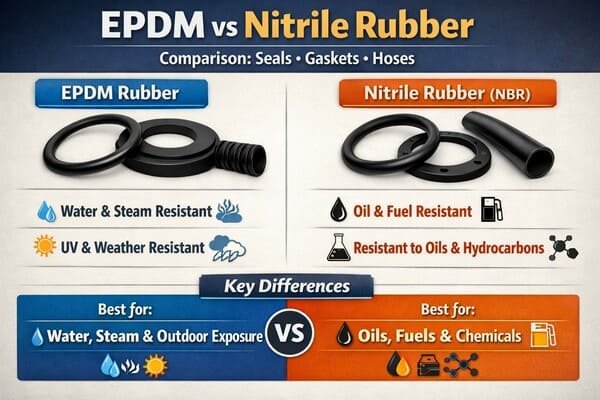
When buyers ask me which one is “better,” I always slow the conversation. There is no better rubber in general. There is only the right rubber for the environment. I learned this after seeing many seals fail for reasons that were easy to predict.
What Is EPDM Rubber and Where Does It Perform Best?
EPDM is often chosen for weather and water, not by habit, but by chemistry.
EPDM rubber is a synthetic elastomer with excellent resistance to water, steam, ozone, UV, and aging, making it ideal for outdoor, HVAC, and water-based sealing applications.
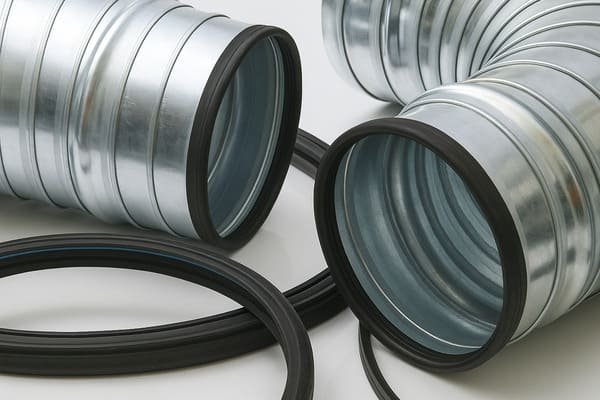
How I describe EPDM in simple terms
EPDM does not like oil. But it loves weather. Its polymer backbone is stable in air, sunlight, and moisture. That makes it predictable over time.
Key strengths I rely on:
- Strong resistance to ozone and UV1
- Stable in hot water and steam2
- Good flexibility over a wide temperature range3
- Long service life outdoors4
Typical EPDM applications I see every week
| Application | Why EPDM works | Common risk if misused |
|---|---|---|
| HVAC gaskets5 | Resists heat, air, ozone | Swells if exposed to oil |
| Roofing seals | UV and weather stability | Oil contamination |
| Water pipe seals6 | Excellent water resistance | Not for petroleum |
| Automotive coolant hoses7 | Handles glycol and heat | Oil mist exposure |
A personal lesson with EPDM
Years ago, a customer used EPDM seals in a system that was mostly water. Then a small oil additive was introduced. Within weeks, the seals swelled and softened. The EPDM was not defective. The environment changed. That failure taught me to always ask about “small chemicals,” not just the main fluid.
🛠️ My rule: EPDM is safe only when oils and fuels are truly absent.
What Is Nitrile Rubber and Why Is It Chosen for Oil Sealing?
Nitrile rubber is built for oil contact. That is its main reason for existence.
Nitrile rubber (NBR) is a synthetic rubber designed for resistance to oils, fuels, and greases, making it a standard choice for hydraulic, pneumatic, and fuel system seals.
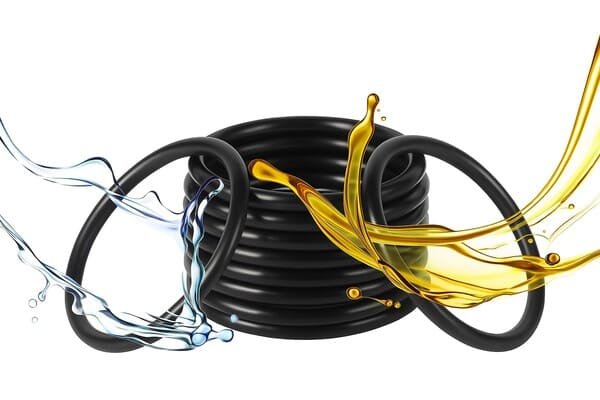
How I explain nitrile behavior
Nitrile contains polar groups that resist hydrocarbon oils. This slows swelling and preserves mechanical strength in oil environments.
Key strengths I rely on:
- Strong resistance to mineral oils and fuels8
- Good abrasion resistance9
- Stable mechanical properties under oil exposure10
- Cost-effective for many industrial systems
Typical nitrile applications in real projects
| Application | Why nitrile is used | Common limitation |
|---|---|---|
| Hydraulic seals | Oil compatibility | Poor ozone resistance |
| Fuel system gaskets | Fuel resistance | Hardens outdoors |
| Industrial hoses | Abrasion + oil | Limited weather life |
| O-rings in machinery | Oil sealing | UV cracking risk |
A production-side observation
I often see nitrile parts returned not because of oil failure, but because of cracking after outdoor storage. The buyer focused on oil resistance and ignored ozone exposure. That mistake is easy to make.
🛠️ My rule: nitrile works in oil, not in open air.
How Do EPDM and Nitrile Compare in Chemical Resistance?
Chemical compatibility11 is where these two materials clearly separate.
EPDM resists water-based fluids and weathering, while nitrile resists oils and fuels but degrades in ozone, UV, and many outdoor conditions.
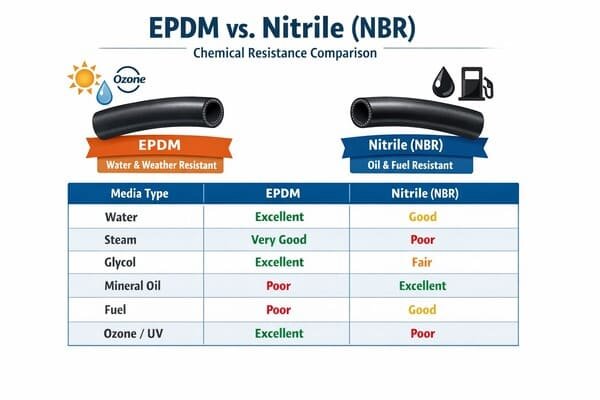
Side-by-side chemical behavior
| Media type | EPDM | Nitrile (NBR) |
|---|---|---|
| Water | Excellent | Good |
| Steam | Very good | Poor |
| Glycol | Excellent | Fair |
| Mineral oil | Poor | Excellent |
| Fuel | Poor | Good |
| Ozone / UV | Excellent | Poor |
Why small exposure matters
Many buyers say “there is no oil.” Then later I learn there is oil mist, lubricant spray, or cleaning residue. Rubber does not care about intent. It only reacts to chemistry.
That is why I always ask for a full media list, even trace exposure.
How Do Temperature and Aging Affect EPDM and Nitrile?
Temperature and time expose the real limits of rubber.
EPDM generally offers better high-temperature aging in air and steam, while nitrile performs better in oil but hardens faster under heat and ozone exposure.
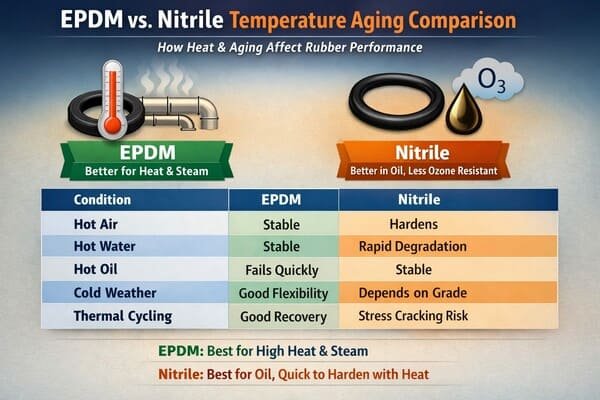
Typical temperature behavior I see
| Condition | EPDM | Nitrile |
|---|---|---|
| Hot air | Stable | Hardens |
| Hot water | Stable | Rapid degradation |
| Hot oil | Fails quickly | Stable |
| Cold weather | Good flexibility | Depends on grade |
| Thermal cycling | Good recovery | Stress cracking risk |
Aging is not only temperature
Time under compression matters. EPDM often shows low compression set in water and air. Nitrile often performs well in oil, but loses elasticity in dry heat.
🛠️ My habit: I never judge rubber life without knowing temperature, media, and time together.
How Do EPDM and Nitrile Compare in Sealing Performance?
Sealing is about recovery and contact pressure, not only hardness.
EPDM often provides stable long-term sealing in water and air systems, while nitrile provides reliable sealing in oil systems as long as ozone and weather are controlled.
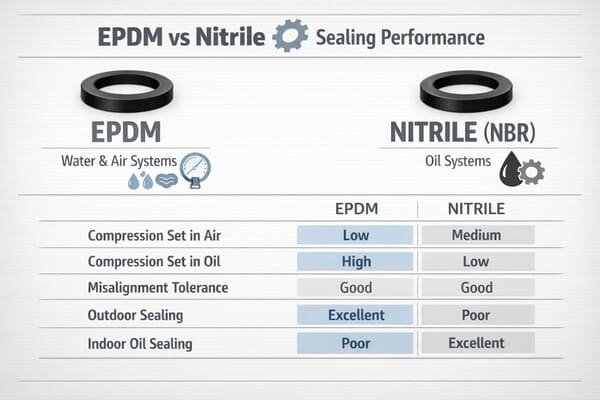
| Factor | EPDM | Nitrile |
|---|---|---|
| Compression set in air12 | Low | Medium |
| Compression set in oil | High | Low |
| Tolerance to misalignment | Good | Good |
| Outdoor sealing | Excellent | Poor |
| Indoor oil sealing | Poor | Excellent |
A sealing failure I often prevent
I often stop buyers from using nitrile in HVAC flanges exposed to sunlight. The seal may pass pressure tests, then crack within a year. EPDM lasts much longer in that case.
How Do I Choose Between EPDM and Nitrile for Real Projects?
The choice should start from the environment, not from habit or price.
I choose EPDM or nitrile by listing all fluids, temperature ranges, and exposure conditions, then validating compression set and aging performance under real use conditions.
My practical decision logic
- Is oil or fuel present, even in small amounts?
- Is the part exposed to ozone, UV, or outdoor air?
- Is the system water-based or oil-based?
- What is the operating temperature over time?
Quick selection guide
| Scenario | My choice | Reason |
|---|---|---|
| Outdoor HVAC gasket | EPDM | Weather + air |
| Hydraulic cylinder seal13 | Nitrile | Oil contact |
| Hot water system | EPDM | Water + heat |
| Fuel line O-ring14 | Nitrile | Fuel resistance |
| Mixed oil + ozone | Neither | Consider FKM15 or HNBR |
Many failures come from “almost correct” material choices. EPDM and nitrile are both excellent rubbers. They just live in different worlds.
Conclusion
EPDM and nitrile serve different environments. EPDM wins in water and weather. Nitrile wins in oil and fuel. Choosing correctly prevents most sealing failures.
-
Understanding the benefits of ozone and UV resistance can help in selecting the right materials for outdoor applications. ↩
-
Explore how stability in hot water and steam affects the longevity and performance of rubber materials in various applications. ↩
-
Learn why flexibility across temperatures is crucial for the performance of rubber seals in diverse environments. ↩
-
Discover factors that influence the outdoor service life of rubber materials and how to maximize their durability. ↩
-
Explore this resource to understand the best materials for HVAC gaskets, ensuring durability and efficiency in your systems. ↩
-
Explore this resource to understand optimal usage and avoid common pitfalls with water pipe seals. ↩
-
Explore this resource to understand the ideal materials for automotive coolant hoses, ensuring durability and performance. ↩
-
Understanding nitrile's resistance to oils can help in selecting the right materials for oil-related applications. ↩
-
Explore the importance of abrasion resistance in rubber and how it impacts the longevity of seals and gaskets. ↩
-
Learn about the stability of rubber's mechanical properties in oil environments and its implications for performance. ↩
-
Understanding chemical compatibility can help prevent failures in rubber applications due to improper material selection. ↩
-
Learn about compression set and its significance in evaluating the performance of rubber seals in different environments. ↩
-
Explore this resource to understand the best materials for hydraulic cylinder seals, ensuring optimal performance and longevity. ↩
-
Explore this resource to understand the best materials for fuel line O-rings, ensuring optimal performance and safety. ↩
-
Explore this resource to understand FKM's superior chemical resistance, ideal for oil and fuel applications. ↩