
Oil leaks are small at first. Then the equipment gets dirty. Then the seal swells or hardens. Then the downtime bill arrives.
For most oil-resistant seals, I start with NBR for general mineral oils, HNBR for oil + higher heat and longer life, and FKM (Viton®) for hot oils, fuels, and aggressive fluids. The “best” elastomer depends on your oil type, temperature, pressure, and sealing design.

I have seen many buyers ask for “the best oil rubber” like it is a single answer. I do not blame them. Procurement needs speed. Engineering needs safety. I keep both by using a clear selection logic and a short validation test plan.
What does “oil resistant” really mean for a seal?
Oil resistance sounds simple. In real projects, it is not simple. A seal can “resist oil” and still fail because the rubber swells, or the hardness drops, or the compression set rises. That is why I define oil resistance with three results, not one.
Oil resistance for seals means the rubber keeps its size, hardness, and sealing force after contact with the real oil at the real temperature for the real time. Swell, hardness change, and compression set tell me more than a marketing claim.
I use three numbers to talk about oil resistance
I keep these three checks in my quotes and my sample plans. They stop most wrong selections.
- ✅ Volume change (swell/shrink)1: A swollen seal can jam grooves or lose squeeze control. A shrunken seal can leak fast.
- ✅ Hardness change2: A big drop in Shore A can reduce contact stress. A big increase can create cracks.
- ✅ Compression set after aging3: A seal can look fine, but it can lose elastic recovery. Then it leaks during pressure cycling.
Oil type matters more than most people expect
I always ask what “oil” means in your plant. Many oils are not equal.
- Mineral oil hydraulic oil
- Engine oil with additives
- Gear oil with EP additives
- ATF4
- Bio-based oils5
- Fuels (gasoline, diesel, blends)6
- Compressor oils
Even if the base oil is similar, additive packages can change rubber behavior. That is why I push for a media list, even a short one.
Quick reference table: what I expect in oil service
| What I observe in the field | What it often means | What I check next |
|---|---|---|
| Seal grows and feels soft | High swell, plasticization | ISO 18177 / ASTM D4718 immersion + hardness |
| Seal shrinks and cracks | Extractables, low-temp brittleness, wrong polymer | Low-temp check + aging in real oil |
| Seal leaks after heat soak | Compression set and stress relaxation | ISO 815 / ASTM D395 compression set9 |
| Seal surface becomes sticky | Incompatible oil or high temperature | Oil type confirmation + FKM/HNBR review |
A short story from my own work
I once worked on a pump seal that “passed” a standard oil immersion test. The part still leaked in the customer’s test loop. The oil was not the same. The customer used a different additive package and higher peak temperature. My team changed the rubber, and we changed the test oil. The problem stopped. I learned to treat “oil” as a specification, not a word.
Is NBR always the best for oil resistant seals?
Many buyers expect NBR to win because it is the classic oil rubber. NBR is a strong baseline. It is not always the best.
NBR is often the best first choice for mineral oils at moderate temperature because it balances oil resistance, mechanical strength, and cost. It stops being the best when heat, long life, fuels, or aggressive additives drive swelling and compression set risk.

Why I like NBR as a starting point
NBR works well in many hydraulic systems and oil-contact parts. It is also easy to source in stable quality when the compound is well-controlled.
✅ What I often like about NBR:
- Good resistance to many mineral oils
- Strong practical performance in O-rings, gaskets, and molded seals
- Good price level for large programs
- Many hardness options (like 60–90 Shore A)
Where NBR can fail in oil service
NBR can struggle when the temperature rises and stays high. It can also struggle with fuels and some modern fluids. The failure is often slow. It looks like “aging.” It is not bad luck. It is polymer physics.
✅ Common NBR risk points I look for:
- Higher continuous temperature
- Long maintenance intervals
- High pressure + micro-movement
- Fuel exposure (not just oil)
- Rapid pressure cycles that punish compression set
What I specify when I quote NBR for oil seals
I try to make NBR predictable. I do not want surprises in the warehouse.
- I specify the hardness target and tolerance (because hardness drift changes squeeze force).
- I specify compression set limits after heat aging.
- I request oil immersion data10 in a defined oil and time.
- I ask for the real oil name if you can share it.
Practical NBR use cases I see every week
- Hydraulic cylinders and valve blocks (mineral oil, normal heat)
- Oil splash seals in gearboxes
- General industrial oil gaskets with standard service temperature
If your application is in this zone, NBR is usually my first answer. If your application is outside this zone, I move fast to HNBR, FKM, or other polymers.
When does HNBR beat NBR for oil resistance?
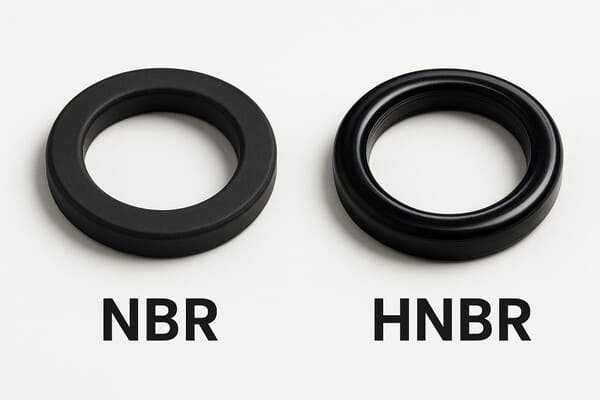
HNBR is not just “better NBR.” It is a different performance balance. I use it when I want more heat resistance and longer life in oil.
HNBR often beats NBR when oil resistance must stay stable at higher temperature, under long aging time, and under dynamic stress. HNBR is also a strong option for automotive-style fluids and demanding industrial duty cycles.
What I expect HNBR to improve
HNBR usually improves heat aging resistance11 and mechanical durability. It often reduces property drift over time. That matters for long service intervals.
✅ What I often gain with HNBR:
- Better heat aging stability than NBR
- Better tear and abrasion resistance12 in many compounds
- Better retention of sealing force after aging (lower compression set risk in many designs)
When HNBR is not worth it
HNBR is more expensive than NBR. I do not push it when the temperature is low and the service life target is short. I also do not treat it as a fuel rubber for all cases. Fuel blends still need careful checks.
My decision triggers for switching from NBR to HNBR
I switch when I see one or more of these triggers:
- ✅ Continuous temperature rises above the safe zone for standard NBR
- ✅ The seal must survive long heat soak without losing squeeze
- ✅ The system has frequent pressure pulses
- ✅ The seal sees both oil and mechanical wear
Comparison table: NBR vs HNBR in oil seals
| Factor | NBR (typical) | HNBR (typical) | What I do with this |
|---|---|---|---|
| Mineral oil resistance | Good | Good to very good | Both can work, I use temperature to decide |
| Heat aging | Moderate | Better | I pick HNBR for hotter and longer life |
| Compression set at heat | Moderate | Often better | I validate with ISO 815 / ASTM D395 |
| Cost | Lower | Higher | I use HNBR only when risk justifies it |
| Dynamic wear | Good in many cases | Often better | I pick HNBR for moving seals |
If you want a clean rule, I use this: NBR is my baseline for oil. HNBR is my upgrade when the same seal must stay tight after long heat aging.
When should I choose FKM (Viton®) for oil and fuel exposure?
FKM is the material many buyers request first. I understand why. It has a strong reputation in oils, fuels, and high temperature. It is not the right answer for every seal, and it is not always the cheapest “insurance.”
I choose FKM (Viton®) when the seal must handle hot oils, fuels, or aggressive fluids, and when long-term heat aging is a real risk. I still confirm low-temperature flexibility and compression set because some FKM grades can get stiff in cold conditions.

Where FKM performs well in real systems
FKM is often the correct tool for:
- Hot engine oils and hot compressor oils
- Fuel vapor exposure and fuel contact parts
- Some chemical environments mixed with oil
- High temperature service where NBR drifts too much
✅ I like FKM when:
- Heat is high and continuous
- Fuel is part of the real media list
- Additives are aggressive
- The project needs long life with stable properties
The two FKM traps I watch for
1) Cold flexibility: Some FKM compounds can stiffen at low temperature. A seal can leak during cold start even if it survives heat.
2) Cost without value: If the system is moderate temperature mineral oil only, FKM can be expensive overkill.
My FKM selection checklist
I keep it simple and practical:
- What is the minimum operating temperature?
- Is the exposure immersion, splash, or vapor?
- What is the pressure cycle profile?
- What is the seal geometry13 and squeeze range14?
- What is the hardness target (often 70–90 Shore A)?
Quick comparison table: HNBR vs FKM for oil service
| Factor | HNBR | FKM | What it means for you |
|---|---|---|---|
| Mineral oils | Strong | Strong | Both can work |
| Fuels | Needs care | Often strong | I often prefer FKM for fuels |
| High temperature | Better than NBR | Often best | I use FKM when heat is the main risk |
| Low temperature | Often better | Grade dependent | I check cold start risk for FKM |
| Cost | Medium | Higher | I justify it with risk and life |
When a buyer asks me, “Which one is the best oil rubber?” I often answer, “Tell me if fuel and heat are part of the story.” That single detail changes the material.
What about ACM, AEM, and other “oil rubbers” used in automotive?
Some buyers only compare NBR, HNBR, and FKM. Automotive and transmission systems often use ACM and AEM too. These materials can be very strong in hot oil, with a different balance of properties.
ACM and AEM are often chosen for hot oil environments in automotive systems when long heat aging stability is needed, and when the design is proven for those materials. They are not universal materials, so I use them mainly when the application matches common automotive patterns.

Why ACM and AEM exist in real production
ACM and AEM sit in a practical space:
- They can handle hot oils well in many conditions.
- They can be cost-effective in the right design.
- They are common in specific automotive sealing locations.
When I consider ACM or AEM
I consider them when:
- The part is modeled on an existing automotive design
- The oil is hot and the duty cycle is stable
- The customer values proven material families used in similar programs
When I avoid them
I avoid them when:
- The environment is mixed with unknown chemicals
- The temperature swings are extreme
- The project needs very wide media compatibility
Practical “shortlist” table I use for buyers
| Material family | What it is often used for | What I confirm before I recommend it |
|---|---|---|
| ACM | Hot oil seals in automotive | Temperature profile and oil type15 |
| AEM | Hot oil + better flexibility than ACM in some cases | Cold start risk and long aging |
| NBR | General mineral oils | Heat aging target |
| HNBR | Oil + higher heat + longer life | Compression set at heat |
| FKM | Hot oils + fuels + many chemicals | Cold flexibility and grade choice |
If your team already uses ACM or AEM in a similar part, I can match that approach. If your team does not, I often stay with the more common industrial choices unless there is a clear reason to switch.
How do I choose the best oil-resistant elastomer for my exact seal design?
This is the section where I slow down. Material choice is not only chemistry. It is also seal geometry13, squeeze, surface finish, and movement. A good rubber in a bad design still leaks.
I choose the best oil-resistant elastomer by locking four inputs: oil type, temperature range, seal movement, and acceptance tests. Then I pick a material family and tune hardness and compound details to control swell and compression set.

Step 1: I map the exposure type
Exposure drives swelling risk and extraction risk.
- Immersion: highest swell risk
- Splash: medium risk, often easier than immersion
- Vapor: can attack rubber in a different way, often overlooked
Step 2: I lock the temperature truth
I always ask for:
- Continuous temperature
- Peak temperature and duration
- Cold start temperature
Heat changes everything. It speeds up aging. It changes compression set. It can turn a “good” oil compound into a leak.
Step 3: I set hardness based on seal mechanics
Hardness is not only a number on the datasheet. It is sealing force.
✅ My quick rule:
- I use softer rubber when surfaces are rough and pressure is lower.
- I use harder rubber when pressure is higher and extrusion risk is real.
- I still validate compression set because harder does not always mean better sealing over time.
Step 4: I confirm certification needs early
Certification is often a procurement gate. I do not want late surprises.
- If the seal is in food contact, I check food-contact compliance needs.
- If the seal is in regulated equipment, I check documentation needs.
- If the seal is in automotive supply chains, I check PPAP-style expectations16.
Performance comparison table for procurement teams
| Elastomer | Oil resistance (mineral oil) | Fuel resistance | Heat capability (general) | Cold flexibility (general) | Typical “best fit” I see |
|---|---|---|---|---|---|
| NBR | Strong | Limited to fair | Moderate | Good | Hydraulic oil seals, general oil gaskets |
| HNBR | Strong | Better than NBR in many cases | Higher | Good | Oil seals with higher heat and long life |
| FKM (Viton®) | Strong | Strong | High | Grade dependent | Hot oils, fuels, aggressive service |
| ACM | Strong in its niche | Limited | High in many oil cases | Limited | Proven automotive hot oil applications |
| AEM | Strong in its niche | Better than ACM in some cases | High | Better than ACM in some cases | Transmission-style oil sealing duty |
| EPDM | Poor | Poor | Moderate | Good | I do not use it for oils and fuels |
| VMQ (Silicone) | Weak in oils | Weak in fuels | High in hot air | Excellent | Not my choice for oil sealing |
What I ask for when I want to remove risk fast
If you want speed and safety, I ask for these items:
- Oil name or datasheet
- Temperature range (min/normal/max)
- Pressure and movement description
- Target service life
- Acceptance tests: immersion + compression set + dimensional check
If you want, you can also share a simple drawing. I can propose a compound direction and a test plan based on your real conditions.
If you also want to review related sealing options, I keep these pages updated on my site:
Conclusion
I do not chase a single “best” elastomer. I match oil type, temperature, and seal design, then I validate with immersion and compression set tests.
-
Understanding volume change can help prevent seal failures and leaks in various applications. ↩
-
Learn how hardness variations can influence the durability and effectiveness of seals. ↩
-
Explore the importance of compression set in maintaining seal integrity over time. ↩
-
Explore the applications and benefits of Automatic Transmission Fluid (ATF) in various systems. ↩
-
Discover the benefits of using bio-based oils in industrial applications. ↩
-
Understand the compatibility of various fuels with different seal materials. ↩
-
Learn about the ISO 1817 standard and its role in evaluating rubber resistance to liquids. ↩
-
Explore the ASTM D471 standard for assessing rubber's resistance to petroleum products. ↩
-
Understand the concept of compression set and its impact on seal performance. ↩
-
Learn how oil immersion data helps predict seal performance in real-world conditions. ↩
-
Discover how heat aging resistance affects the longevity of rubber seals. ↩
-
Learn about the significance of tear and abrasion resistance in ensuring seal durability. ↩
-
Discover the relationship between seal geometry and its effectiveness in preventing leaks. ↩ ↩
-
Understand how the squeeze range impacts the sealing effectiveness and longevity. ↩
-
Discover how different oil types can significantly affect seal performance and longevity. ↩
-
Understand the significance of PPAP in ensuring quality and compliance in automotive parts. ↩


