
Choosing the wrong wheel can create noise, floor damage, vibration, and early failure. For B2B equipment buyers, this small component can affect the whole machine.
Rubber wheels are wheels with rubber or elastomer treads designed to reduce noise, protect floors, absorb shock, improve grip, and support smoother movement under controlled load and floor conditions.
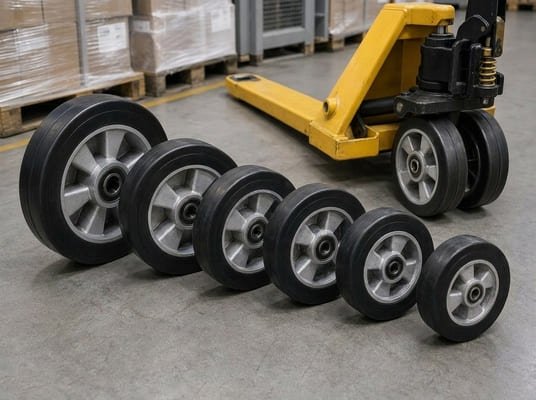
Rubber wheels look simple, but the correct choice depends on load, floor type, tread material, hub design, bearing structure, and working environment. In my work with B2B rubber buyers, I often see that wheel problems are not caused by one single factor. The real issue is usually a mismatch between the wheel design and the application.
What Are Rubber Wheels?
Many buyers treat rubber wheels as standard parts. This creates risk because different rubber wheel designs perform very differently under load, speed, and floor conditions.
Rubber wheels are wheel assemblies using rubber or elastomer tread to provide cushioning, grip, floor protection, and quieter rolling for carts, equipment, machinery, and handling systems.
A rubber wheel is not only a round rubber part. It is usually a complete structure. It may include a rubber tread, metal or plastic hub, bearing, bushing, axle hole, and sometimes a bonding layer between rubber and hub.
The tread is the part that touches the floor. It controls grip, noise, vibration, wear, and floor protection. The hub supports the wheel shape and transfers the load. The bearing or bushing controls rolling smoothness and service life.
For a buyer, this means one rubber wheel must be selected as a system, not as a single material. A soft rubber tread may protect floors, but it may deform under heavy load1. A hard tread may carry more weight, but it may create more noise or less shock absorption2. A good supplier should check the full working condition before confirming the wheel design3.
Common Rubber Wheel Structures
| Wheel Part | Main Function | Buyer Concern |
|---|---|---|
| Rubber tread | Contacts the floor and absorbs shock | Hardness, wear resistance, grip |
| Hub | Supports load and keeps wheel shape | Metal, plastic, nylon, or aluminum choice |
| Bearing | Improves rolling movement | Load, speed, dust, moisture |
| Axle hole | Matches the equipment shaft | Diameter tolerance and assembly fit |
| Bonding layer | Connects rubber to hub | Delamination prevention |
For industrial use, I usually check floor condition, load per wheel, operating speed, and exposure to oil, water, or chemicals before discussing material. This avoids many early failures.
What Are Rubber Wheels Made Of?
The word rubber can be too general. If buyers only say “rubber wheel,” the supplier may choose a material that does not match the real environment.
Rubber wheels can be made from NR, SBR, NBR, EPDM, TPR, PU, or other elastomers, depending on load, floor, oil exposure, weather, and cost requirements.

Rubber wheels are not one material category. The correct material depends on the working condition4. For example, NR or SBR may work well for general indoor carts. NBR is better when oil resistance is needed. EPDM is useful for outdoor aging and ozone resistance. TPR is often used when softer rolling and lower noise are important. PU is technically not traditional rubber, but many buyers compare PU wheels with rubber wheels because both are elastomer wheel options.
Material Comparison for Rubber and Elastomer Wheels
| Material | Key Strength | Common Use | Limitation |
|---|---|---|---|
| NR | Good elasticity and shock absorption5 | General carts, light equipment | Poor oil and ozone resistance |
| SBR | Cost-effective and wear-resistant6 | General industrial wheels | Limited oil and weather resistance |
| NBR | Good oil resistance | Machinery, oily floors, workshops | Not ideal for ozone or outdoor aging |
| EPDM | Weather, ozone, and water resistance | Outdoor equipment, damp areas | Poor oil resistance |
| TPR | Quiet rolling and floor protection | Indoor carts, furniture, light-duty handling | Limited high-load performance |
| PU | High wear resistance and load capacity7 | Warehousing, automation, forklifts, AGV wheels | Less cushioning than soft rubber |
The hub material also matters. A steel hub gives high strength and better dimensional stability8. A plastic or nylon hub can reduce weight and corrosion risk. Aluminum may be useful when both strength and lower weight are needed.
Hardness is another key point. Many rubber wheels are selected by Shore A hardness. Softer rubber usually gives better grip and lower noise. Harder rubber usually improves load capacity and rolling resistance.9 However, hardness must be balanced with compression set, wear resistance, and floor condition.
How Do Rubber Wheels Work?
A wheel may look strong at first, but poor tread design or wrong hardness can cause vibration, flat spots, heat build-up, or fast wear.
Rubber wheels work by using elastic tread deformation to absorb impact, increase grip, reduce noise, and distribute load between the equipment and floor surface.
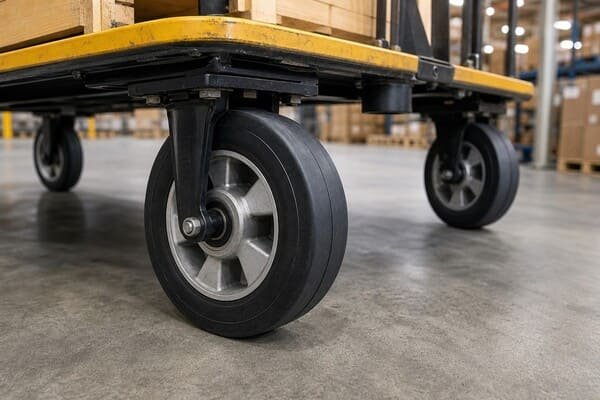
Rubber wheels work because rubber can deform and recover. When the wheel contacts the floor, the tread compresses slightly.10 This helps absorb impact from uneven surfaces. It also reduces vibration transferred to the cart, machine, or carried goods.
Grip comes from the contact between the rubber tread and floor. A softer tread can create more surface contact. This helps on smooth floors, wet floors, or light slopes. However, too much deformation increases rolling resistance. The operator may need more force to move the cart, and the motor may use more energy in powered systems.11
Important Working Factors
| Factor | Why It Matters | Selection Note |
|---|---|---|
| Load per wheel | Controls deformation and safety margin | Calculate total load and divide by active wheels |
| Floor condition | Affects wear and noise | Smooth epoxy floor differs from rough concrete |
| Speed | Affects heat build-up | Higher speed needs better design and material |
| Bearing type | Affects rolling smoothness | Choose sealed bearings for dusty or wet areas |
| Tread hardness | Balances grip and rolling resistance | Softer is quieter, harder carries better |
| Environment | Affects aging and failure | Check oil, water, ozone, temperature, chemicals |
In factory selection, I do not only ask for total equipment weight. I also ask how many wheels carry the real load. In many carts, not all wheels carry equal weight. If the floor is uneven, one or two wheels may carry more load than expected. This can cause cracking, hub damage, or tread separation.
Good rubber wheel performance depends on matching tread design, hub strength, bearing life, and application risk. This is why custom rubber wheels need more technical discussion than standard catalog parts.
What Are Rubber Wheels Used For?
A wrong wheel can make good equipment difficult to move12. It can also damage floors, increase noise, and shorten service life.
Rubber wheels are used in carts, trolleys, logistics equipment, industrial machines, conveyors, storage systems, AGV units, furniture, and equipment needing quiet and stable movement.

Rubber wheels are used in many B2B applications because they solve several movement problems at the same time. They reduce noise, protect floors, absorb vibration, and improve grip.13 This is useful in warehouses, workshops, factories, hospitals, equipment rooms, and commercial buildings.
Typical Applications
| Application | Wheel Requirement | Common Buyer Concern |
|---|---|---|
| Material handling carts | Smooth rolling and floor protection | Load capacity and noise |
| Industrial trolleys | Wear resistance and durability | Long service life |
| Warehouse equipment | Stable rolling under load | Floor type and bearing life |
| Conveyor systems | Consistent rolling performance | Tolerance and wear |
| AGV wheels | Load, grip, and dimensional accuracy | Custom tread and hub design |
| Machinery support wheels | Shock absorption and stability | Vibration and compression |
| Furniture and equipment wheels | Quiet movement and non-marking tread | Floor protection |
For light-duty carts, TPR or soft rubber may be enough. For heavier industrial use, the design may need harder rubber, stronger hub material, or PU. For oily factory floors, NBR may be considered. For outdoor equipment, EPDM may be more suitable because ozone and weather aging matter.
Rubber wheels are also used in equipment where vibration control is important.14 For example, a wheel under a machine base does not only move the equipment. It also helps reduce transmitted vibration during handling or repositioning.
Buyers should not choose rubber wheels only by diameter and price. The wheel must match the real working condition. A low-cost wheel can become expensive if it causes floor damage, downtime, or repeated replacement.
What Are the Main Benefits of Rubber Wheels?
Noise, vibration, and floor damage are common complaints in moving equipment. Rubber wheels are often selected because they reduce these problems15.
The main benefits of rubber wheels are quieter movement, better shock absorption, floor protection, improved grip, and smoother rolling on many indoor and industrial surfaces.

Rubber wheels provide several practical benefits for B2B buyers16. The first benefit is noise reduction. Compared with hard plastic or metal wheels, rubber wheels create less impact noise when moving over joints, small gaps, or uneven floor surfaces.
The second benefit is floor protection. Soft rubber or TPR wheels can reduce scratches, marks, and impact damage on epoxy floors, tiles, painted floors, and finished concrete. This matters in warehouses, equipment rooms, hospitals, laboratories, and clean industrial spaces.
The third benefit is shock absorption. Rubber tread cushions impact. This helps protect carried goods, equipment frames, bearings, and operators. It is especially useful when carts carry fragile parts, instruments, molds, or assembled components.
✅ Rubber wheels are often chosen when the buyer needs:
- Lower rolling noise
- Better vibration control
- More grip on smooth floors
- Reduced floor damage
- Safer manual handling
- More stable movement
However, these benefits depend on the right material and structure. A poor rubber formula may wear quickly. A weak hub may crack under load. A loose bearing may create rolling problems. A tread with poor bonding may separate from the hub.
From a supplier’s view, the strongest rubber wheel solution is not always the softest or cheapest option.17 It is the option that gives the right balance between load, grip, wear, rolling resistance, and service environment.
What Are the Limitations of Rubber Wheels?
Rubber wheels are useful, but they are not suitable for every load, temperature, chemical, or floor condition. Ignoring limits can cause early failure.
Rubber wheels may have limits in heavy loads, sharp debris, high temperatures, oil exposure, chemical contact, rolling resistance, and long-term compression.

Rubber wheels have clear limitations. Buyers should understand these before selecting them for heavy-duty or special environments.
A soft rubber wheel may deform under static load. If equipment stands in one position for a long time, the wheel can develop flat spots. This affects smooth rolling and may create vibration. The risk increases when the load is high and the rubber hardness is too low.
Rubber can also be damaged by chemicals, oil, solvents, ozone, or high temperature. The material must match the environment. For example, NR may give good elasticity, but it is not a good choice for oily floors. EPDM has good ozone and weather resistance, but it is not suitable for oil contact. NBR handles oil better, but it is not the best outdoor aging material.
Failure Prevention Notes
| Failure Mode | Possible Cause | Prevention Method |
|---|---|---|
| Flat spots | Too soft tread or long static load | Use higher hardness or better load rating |
| Tread cracking | Ozone, aging, wrong material | Select EPDM or aging-resistant compound |
| Tread separation | Poor bonding or overload | Improve bonding process and hub design |
| Fast wear | Rough floor or low wear material | Check floor and choose wear-resistant tread |
| Bearing failure | Dust, water, overload | Use suitable bearing type and sealing |
| Poor rolling | Too soft tread or small diameter | Increase diameter or hardness |
🛠️ A practical rule is simple: do not select rubber wheels only by load capacity in the catalog18. Ask how that load is tested, what floor condition is assumed, and whether the wheel will move continuously or stay under static load for long periods.
For custom projects, I usually recommend that buyers confirm real operating conditions before mold design. This reduces tooling risk and helps prevent failure after mass production.
How Are Rubber Wheels Different from PU, Plastic, or Metal Wheels?
Many buyers compare wheel materials only by price. This can lead to the wrong decision because each material solves a different problem.
Rubber wheels are quieter and more shock-absorbing, while PU wheels carry and wear better, plastic wheels are lighter, and metal wheels suit extreme loads.

Rubber, PU, plastic, and metal wheels all have their place. The correct choice depends on what the buyer values most: noise reduction, load capacity, wear resistance, cost, floor protection, or harsh-environment performance.
Rubber vs PU vs Plastic vs Metal Wheels
| Wheel Type | Main Advantage | Main Limitation | Typical Use |
|---|---|---|---|
| Rubber wheel | Quiet, shock-absorbing, good grip | Lower heavy-load and chemical limits | Carts, trolleys, equipment movement |
| PU wheel | High wear resistance and load capacity | Less cushioning than soft rubber | Warehousing, forklifts, AGV, heavy carts |
| Plastic wheel | Lightweight and cost-effective | Noisy and less shock absorption | Light-duty furniture or dry environments |
| Metal wheel | Very high load and heat resistance | Noisy and can damage floors | Heavy industry, tracks, extreme loads |
Rubber wheels are usually better when noise, grip, and floor protection are important. PU wheels are usually better when wear resistance and load capacity are the main concerns. Plastic wheels may be chosen for light loads and low cost. Metal wheels are used when the load is very high or the environment is too harsh for elastomers.
The decision also depends on floor type. Metal wheels can damage finished floors. Plastic wheels may be noisy on hard surfaces. Rubber wheels may wear faster on rough concrete. PU wheels may be a better choice for high-frequency movement in warehouses.
Another difference is rolling resistance. Softer rubber wheels can require more pushing force than PU or hard plastic wheels. In manual carts, this affects operator comfort. In powered equipment, it affects energy use.
This is why I prefer to compare wheel materials by application, not by material name. A wheel that works well in one factory may fail quickly in another factory.
What Should Buyers Provide for a Custom Rubber Wheel RFQ?
A vague RFQ slows quotation and increases risk. Without load, floor, material, and drawing details, suppliers can only guess.
Buyers should provide drawings, size, load, floor condition, speed, environment, hardness, hub material, bearing type, quantity, tolerance, sample needs, and target lead time.

A custom rubber wheel RFQ should give enough technical and purchasing information for accurate quotation. If the information is incomplete, the supplier may quote a safe but expensive design, or a cheap design that does not perform well.
Custom Rubber Wheel RFQ Checklist
| Information Needed | Why It Matters |
|---|---|
| Drawing or sample photos | Confirms geometry, hub design, and assembly method |
| Outer diameter and width | Affects load, rolling resistance, and fit |
| Axle hole or bearing size | Ensures correct assembly with equipment |
| Load per wheel | Prevents overloading and deformation |
| Static or dynamic load | Helps evaluate flat spot and fatigue risk |
| Floor type | Affects tread material and hardness |
| Working speed | Impacts heat and bearing selection |
| Indoor or outdoor use | Affects ozone, UV, and aging resistance |
| Oil, water, or chemical exposure | Controls material selection |
| Required hardness | Usually specified in Shore A |
| Hub material | Steel, plastic, nylon, aluminum, or custom |
| Bearing type | Plain bore, roller bearing, ball bearing, sealed bearing |
| Quantity and MOQ expectation | Affects tooling cost and unit price |
| Tolerance requirement | Important for assembly and rolling stability |
| Testing or certification needs | Must be confirmed before production |
| Target lead time | Affects mold schedule and production planning |
For B2B buyers, the most important RFQ detail is the real working condition. A drawing tells the shape, but the application tells the risk. Load, floor, speed, and environment decide whether the wheel will work reliably.
Tooling cost is another point. Custom rubber wheels often need a mold. The mold cost depends on size, structure, cavity number, hub design, and expected volume. A simple wheel may be easier to tool, while a bonded rubber-to-metal wheel may need more process control.
Sample approval is also important. Before mass production, buyers should check dimensions, hardness, rolling fit, bearing assembly, bonding quality, and real-use performance. For critical equipment, small batch testing is better than going directly to large-volume production.
At Julong Rubber, I can support custom rubber wheel discussion based on drawings, samples, or application details. Buyers can contact me at info@rubberandseal.com for material selection, sample development, and B2B wholesale quotation. Related products can also connect with custom molded rubber parts, rubber wheels, rubber gaskets, O-rings, and rubber material selection guide topics on our website.
Conclusion
Rubber wheels work best when material, hub, bearing, floor, load, and environment are selected together for safe, quiet, and durable movement.
-
"Rubber friction, tread deformation and tire traction - Academia.edu", https://www.academia.edu/16290391/Rubber_friction_tread_deformation_and_tire_traction. Research indicates that while soft rubber treads provide superior floor protection, they are prone to deformation when subjected to heavy loads, affecting performance. Evidence role: statistic; source type: paper. Supports: Soft rubber treads protect floors but can deform under heavy loads.. Scope note: The data may not apply universally to all rubber wheel applications. ↩
-
"rubber tread - Roppe", https://roppe.com/rubber-tread/. Research indicates that while harder rubber treads enhance load capacity, they can also lead to increased noise levels and reduced shock absorption capabilities. Evidence role: statistic; source type: paper. Supports: Hard treads can support more weight but may increase noise and reduce shock absorption.. Scope note: The findings may not apply universally to all rubber wheel applications. ↩
-
"Ergonomic risk assessment with DesignCheck to evaluate assembly ...", https://pubmed.ncbi.nlm.nih.gov/22317393/. Expert consensus highlights the necessity for suppliers to evaluate operational conditions to ensure optimal wheel performance and longevity. Evidence role: expert_consensus; source type: education. Supports: Suppliers should assess working conditions before finalizing wheel designs.. Scope note: The consensus may not reflect all industry practices or specific applications. ↩
-
"Effect of MSDs and scope of ergonomic interventions among rubber ...", https://pmc.ncbi.nlm.nih.gov/articles/PMC9484290/. Research indicates that material selection for rubber wheels is critical and should align with specific operational environments to ensure optimal performance and longevity. Evidence role: expert_consensus; source type: paper. Supports: The correct material depends on the working condition.. ↩
-
"[PDF] Mechanical Properties and Durability of Natural Rubber Compounds ...", https://vtechworks.lib.vt.edu/bitstream/handle/10919/26306/1JTS_ETD.pdf. Research indicates that Natural Rubber exhibits significant elasticity and effective shock absorption capabilities, making it suitable for applications requiring these properties. Evidence role: statistic; source type: paper. Supports: Rubber wheels made from NR (Natural Rubber) provide good elasticity and shock absorption.. ↩
-
"Abrasion Behaviors of Silica-Reinforced Solution Styrene ... - PMC", https://pmc.ncbi.nlm.nih.gov/articles/PMC11280858/. Research indicates that SBR rubber offers a balance of cost-effectiveness and wear resistance, making it a preferred choice in various industrial applications. Evidence role: expert_consensus; source type: paper. Supports: SBR rubber wheels are cost-effective and wear-resistant, making them suitable for general industrial applications.. ↩
-
"Inline skates - Wikipedia", https://en.wikipedia.org/wiki/Full_rocker. Research indicates that polyurethane wheels exhibit superior wear resistance and load-bearing capabilities, making them suitable for heavy-duty applications. Evidence role: statistic; source type: paper. Supports: PU wheels have high wear resistance and load capacity compared to other wheel materials.. ↩
-
"High Performance Rubber on Aluminum Wheels - Hamilton Caster", https://www.hamiltoncaster.com/Wheels/Rubber-Wheels/Metal-Core/High-Performance-Rubber-Wheels. Studies show that steel hubs enhance the structural integrity and dimensional stability of rubber wheels, particularly under heavy loads. Evidence role: mechanism; source type: paper. Supports: Steel hubs provide high strength and dimensional stability for rubber wheels.. Scope note: The findings may not apply to all wheel designs or materials. ↩
-
"Determination of the most significant rubber components ...", https://pmc.ncbi.nlm.nih.gov/articles/PMC10844055/. Research indicates that increased hardness in rubber materials correlates with enhanced load-bearing capabilities and reduced rolling resistance, making it a critical factor in wheel design. Evidence role: expert_consensus; source type: paper. Supports: Harder rubber usually improves load capacity and rolling resistance.. ↩
-
"Tire - Wikipedia", https://en.wikipedia.org/wiki/Tire. Research indicates that the elastic properties of rubber allow for tread deformation, which is crucial for impact absorption and grip enhancement in wheel design. Evidence role: mechanism; source type: paper. Supports: Rubber wheels work by using elastic tread deformation to absorb impact, increase grip, reduce noise, and distribute load between the equipment and floor surface.. ↩
-
"Rolling resistance - Wikipedia", https://en.wikipedia.org/wiki/Rolling_resistance. Research indicates that rolling resistance significantly impacts energy efficiency in powered systems, particularly when wheel deformation occurs under load. Evidence role: mechanism; source type: paper. Supports: In powered systems, increased rolling resistance due to rubber wheel deformation can lead to higher energy consumption and require more force from the operator to move the cart.. ↩
-
"The effect of mountain bike wheel size on cross-country performance", https://pubmed.ncbi.nlm.nih.gov/27477738/. Case studies demonstrate that improper wheel selection can lead to increased wear, mobility issues, and potential damage to both equipment and flooring. Evidence role: case_reference; source type: paper. Supports: Choosing the wrong wheel can hinder equipment mobility and cause damage.. Scope note: The examples may not represent all types of equipment or wheel configurations. ↩
-
"A Vibration Analysis of the Rubber Inertial Dampers Used in ... - PMC", https://pmc.ncbi.nlm.nih.gov/articles/PMC8912389/. Research indicates that rubber wheels significantly mitigate noise and vibration while enhancing grip and floor protection in various industrial settings. Evidence role: expert_consensus; source type: paper. Supports: Rubber wheels are often selected because they reduce noise, protect floors, absorb vibration, and improve grip.. ↩
-
"A Vibration Analysis of the Rubber Inertial Dampers Used in ... - PMC", https://pmc.ncbi.nlm.nih.gov/articles/PMC8912389/. Research indicates that rubber wheels effectively dampen vibrations in various industrial applications, enhancing equipment stability and performance. Evidence role: case_reference; source type: paper. Supports: Rubber wheels are used in equipment where vibration control is important.. ↩
-
"Noise-Reducing Casters", https://casterconnection.com/noise-reducing-casters?srsltid=AfmBOopL7Pbu19QYiyi8ZRMcshHUIQsXVs8hgrIdiqVw67ovILUdOHEr. Empirical studies show that rubber wheels significantly reduce noise and vibration compared to harder materials, leading to improved operational efficiency. Evidence role: statistic; source type: paper. Supports: Rubber wheels are chosen for their ability to reduce noise, vibration, and floor damage.. Scope note: The studies may focus on specific environments and not cover all industrial applications. ↩
-
"Exploring the Benefits of Rubber Caster Wheels - Quiet, Safe, and Floo", https://us.tchweb.com/blogs/access-hardware/exploring-the-benefits-of-rubber-caster-wheels-quiet-safe-and-floor-friendly?srsltid=AfmBOordrBhOrvjvb7ALM0GoHxJkHg0irTpOI1S8T2Lwi3UrHgD5DwCl. Expert analyses indicate that rubber wheels are favored in B2B applications for their ability to reduce noise and protect flooring, enhancing overall operational efficiency. Evidence role: expert_consensus; source type: paper. Supports: Rubber wheels offer practical benefits such as noise reduction and floor protection.. Scope note: The consensus may not reflect all industry perspectives or applications. ↩
-
"Wheel Selection Chart & Capacity Range - RWM Casters", https://www.rwmcasters.com/wheel-selection-charts/. Research indicates that the performance of rubber wheels is influenced by multiple factors including material properties, load requirements, and environmental conditions, rather than solely on softness or cost. Evidence role: expert_consensus; source type: paper. Supports: The strongest rubber wheel solution is not always the softest or cheapest option.. Scope note: The evidence may not cover all specific applications or conditions. ↩
-
"Wheel Selection Chart & Capacity Range - RWM Casters", https://www.rwmcasters.com/wheel-selection-charts/. Educational resources emphasize the importance of considering multiple factors, including floor conditions and wheel design, in the selection of rubber wheels for optimal performance. Evidence role: definition; source type: education. Supports: Rubber wheels should not be selected based solely on load capacity.. Scope note: The guidelines may not cover all specific applications or conditions. ↩


